Never Built to Last: The Political Economy of Mauritius's Permanent Dependency
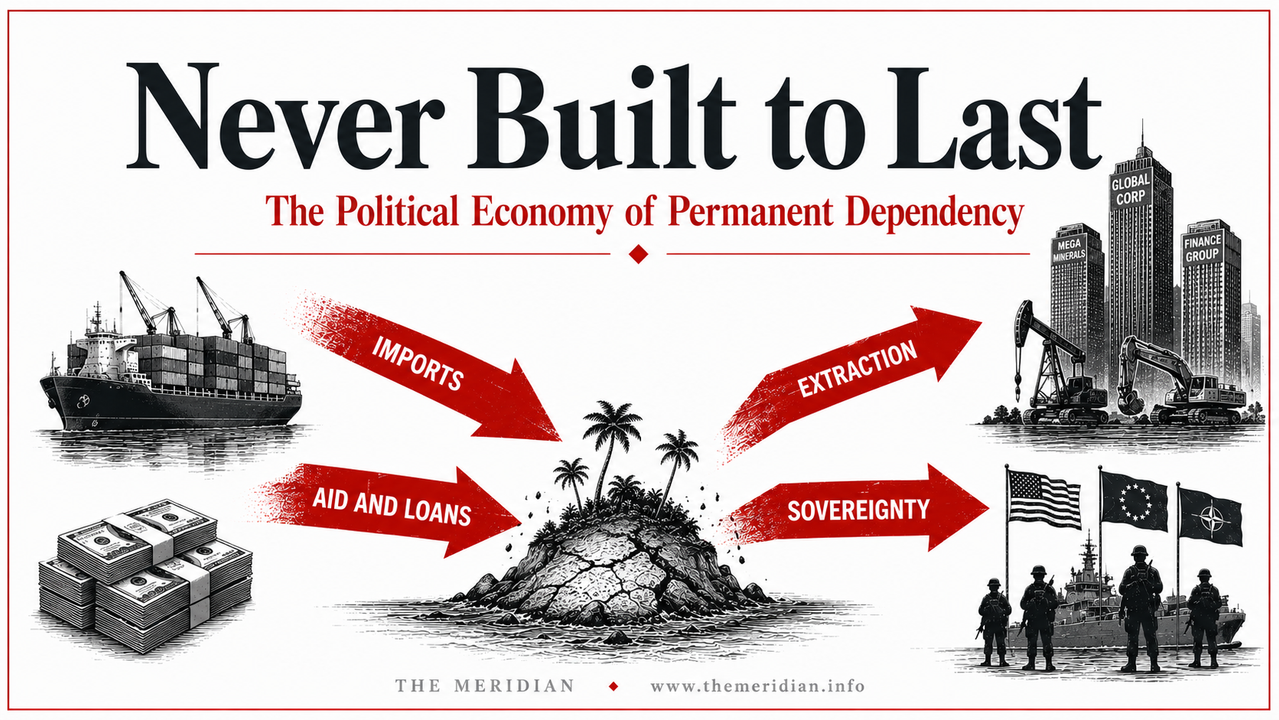
In 1980, Mauritius had absorbed only 8.3 per cent of EEC development aid — the lowest rate among 58 ACP nations. The EEC delegation chief told the Finance Minister: I do not want theoretical exercises. In 2009, Mauritius announced the Rivière des Anguilles dam. In 2023, the Saudi Fund committed $70 million to build it. In May 2026, Mare-aux-Vacoas is at 51 per cent capacity and citizens face two years imprisonment for wasting water. The dam has not been built. The Meridian names what this pattern is: not a series of failures, but a system. Import. Aid. Extract. Repeat. Mauritius was never built to last. The question is whether it was designed not to.
There is a difference between a country that fails to develop and a country that was never designed to develop. The first is a tragedy of circumstance — bad luck, external shocks, limited resources, the compound weight of colonial inheritance. The second is a political economy — a deliberate or emergent set of structural choices that concentrate the benefits of economic activity in the hands of a small number of actors while distributing the costs across the population, generation by generation, in forms that are diffuse enough to be tolerable individually and devastating only when assembled into a single analytical picture. The Meridian has spent May 2026 assembling that picture for Mauritius, article by article, data point by verified data point. This editorial is the synthesis. It names what no individual article could name alone. The model is not a failure of governance. It is the governance. And it has been running, with remarkable consistency, for the better part of six decades.
Lowest of 58 ACP nations. L'Express 22 April 1980
Still not built. Construction now promised Nov 2026
Up from Rs2.5bn at launch. Four times original estimate
Saudi, BADEA, ADFD, AFD, IBRD, India, China, Japan, OFID
Up from Rs165bn in 2014. PwC / IMF Article IV 2025
Falling toward 22%. Citizens face 2 years for water waste
Mauritius import dependency aid loans extract conglomerate sovereignty economy model political economy
Mauritius EEC aid absorption 1980 Lomé bilateral conditional financing governance preference history
The L'Express report of 22 April 1980 is the single most important historical document The Meridian has encountered in this edition. It records the opening of negotiations between the EEC and the Government of Mauritius for the Lomé II aid programme. Finance Minister Sir Veerasamy Ringadoo acknowledged publicly that he was painfully aware that implementation of major projects under Lomé I had not been encouraging. The EEC delegation chief Maurice Foley responded: I want this money, which is yours by right, to be put to work. I do not want theoretical exercises. And then he noted that Mauritius had absorbed only 8.3 per cent of available EEC development aid — the lowest rate of any of 58 ACP countries — while the Comoros, with far fewer resources, had absorbed approximately 98 per cent.
This document is not merely historical. It is the earliest verified data point in a pattern that The Meridian has now documented continuously from 1980 to 2026. The Rivière des Anguilles dam was first announced in 2009 — and the same pattern applies. The money was committed. The design was contracted to Italy's Studio Pietrangeli in 2018. The Saudi Fund signed a $70 million loan agreement in September 2023. BADEA committed $50 million in 2023. The Abu Dhabi Fund for Development signed a co-financing agreement in August 2025. The international tender was launched in late 2025. Construction is now promised to begin in November 2026 and complete in November 2029. Meanwhile the reservoir is at 51 per cent capacity and falling toward 22 per cent. Citizens face two years imprisonment for wasting water. The dam that would have solved the crisis was announced 16 years ago. Nine donors are attached to a project that has not yet broken ground. The original cost estimate of Rs2.5 billion has ballooned to Rs9.4 billion. The pattern from 1980 is identical. Only the project and the decade have changed.
In 1980, the EEC delegation told Mauritius: I do not want theoretical exercises. In 2026, the dam first promised in 2009 has nine donors, a fourfold cost increase and a November 2026 construction start that has been promised in some form every year since 2012. The theoretical exercise has lasted 46 years.
Mauritius infrastructure failure hospitals dam water pipes electricity renewable energy 2026
The Rivière des Anguilles dam is the most dramatic single illustration of the infrastructure delivery failure because of its timeline and its direct connection to the current water crisis. But it is not isolated. The pattern extends across every category of public infrastructure that Mauritius requires to reduce its import dependency and build genuine productive resilience.
The Flacq Teaching Hospital was announced for completion by June 2023. It was inaugurated in August 2024, fourteen months late. It was financed by a $50 million Saudi Fund concessional loan, a Kuwait Fund loan covering 20 per cent of the project, a BADEA contribution covering 15.8 per cent and other Gulf financing. The cancer hospital announced for December 2022 completion was still in construction as of 2025-2026. The Sir Seewoosagur Ramgoolam National Hospital rebuild remains in planning as of May 2026. All specialist doctors in Mauritius are trained abroad because Mauritius has never built the medical education infrastructure — the university faculties in cardiology, oncology, neurosurgery — that would allow it to train its own. For complex cardiac surgery and advanced neurological care, patients are evacuated to India or South Africa. This is not a small island limitation. Singapore, with a comparable historical base, has one of the most advanced medical education systems in the world. The difference is not geography. It is the choice of what to build.
The water pipe network losing 50 per cent of supply to leaks is the same story in a different sector. France committed EUR 200 million for water sector resilience. The UAE co-financed the Mare-aux-Vacoas Water Supply project in 1982. Japan provided grants for disaster prevention infrastructure. The World Bank has engaged on Rodrigues water systems. The financing has been present, across multiple donor relationships, for decades. The pipes still lose half the water. The leaks are not a mystery. They are the accumulated consequence of maintenance investment consistently deferred in favour of announcements. A ribbon-cutting ceremony generates a photograph. A replaced pipe does not. In a political economy organised around the ceremony rather than the outcome, the pipe does not get replaced.
Mauritius sovereignty economy India Agalega China Safe City Diego Garcia France bilateral aid strategic access
The preference for bilateral over multilateral financing is not merely an administrative choice. It is a strategic preference with a specific price. Every bilateral financing relationship that Mauritius has built with a major power comes with a strategic access component that is never published, never debated in Parliament and never subjected to public cost-benefit analysis. India provides $680 million in economic assistance and simultaneously constructs a 3,000-metre airstrip and deep-sea jetty on Agalega capable of supporting P-8I Poseidon maritime surveillance aircraft and naval warships. Both governments deny it is a military base. The infrastructure describes something else. China provides $73.7 million in Export-Import Bank financing for the Huawei Safe City system, secured by a Government of Mauritius sovereign guarantee. The cameras watch. The UK-USA retain Diego Garcia under a 99-year lease as part of the Chagos sovereignty arrangement concluded in 2025. France maintains logistics access through Réunion and bilateral security cooperation agreements. Saudi Arabia and the UAE provide hospital, housing and community financing that sustains influence in the Muslim community, which constitutes approximately 17 per cent of the Mauritian electorate.
Each of these relationships is bilateral, each provides financing without the governance conditionality that the EEC delegation demanded in 1980, and each extracts a piece of Mauritius's sovereign independence in exchange. The island that sits at the centre of the Indian Ocean — carrying 80 per cent of global oil trade, 50 per cent of containerised cargo and 33 per cent of bulk cargo — is simultaneously the host of IORA's secretariat and the subject of surveillance by every major power with a strategic interest in the sea lanes it overlooks. The financing arrives. The sovereignty departs. The infrastructure, which the financing was ostensibly provided to build, is sometimes constructed and sometimes not. The strategic access, however, is always delivered.
The money arrives with bilateral conditions that are never published. The dam arrives with sixteen years of delay and nine donors. The sovereignty departs in instalments. And the citizen is imprisoned for wasting the water the dam would have stored.
Mauritius self sufficiency food energy medical education alternative model development investment
The model The Meridian has described is not inevitable. It is a set of choices, accumulated across decades, that could have been different. The counterfactual is not hypothetical — it is visible in the countries that made different choices from comparable starting points. Singapore, which became independent three years before Mauritius and with fewer natural advantages, built a medical education system, a renewable energy transition framework, a sovereign wealth fund and a digital economy infrastructure that are now among the world's most advanced. Barbados, documented in this edition, built a fiscal primary surplus of 4.2 per cent of GDP, secured a precautionary IMF facility from a position of institutional strength, invested 3 per cent of GDP in climate resilience and is pursuing food self-sufficiency as a formal government strategy. Rwanda, starting from near-zero after genocide, built a healthcare system that has reduced child mortality by 80 per cent in 25 years through sustained domestic investment in primary care infrastructure. The alternative model exists. It has been executed by states with fewer resources than Mauritius and more difficult starting conditions. Its defining feature is the same in every case: the prioritisation of productive capacity over consumption, of domestic institutional quality over bilateral dependency and of citizen welfare over political convenience.
Mauritius had the resources. It received approximately $2.3 to $2.5 billion in foreign financing over the past decade alone, in addition to the decades of bilateral and multilateral financing documented in this edition. It had the intellectual capital — its educated diaspora, its financial services professionals, its academic community. It had the geographic position, the institutional framework and the political stability. What it did not consistently have was the political will to build something that would reduce its dependency rather than reproduce it. Because dependency, in the specific political economy of Mauritius, is not a problem to be solved. It is the mechanism through which power is organised, patronage is distributed and sovereignty is monetised. Building the dam would reduce the water crisis. It would not reduce the financing relationship with the Saudi Fund. Building the medical education faculty would reduce dependence on foreign doctors. It would not reduce the cultural relationship with India. Building the renewable energy infrastructure would reduce the oil import bill. It would not reduce the relationship with France through which climate financing flows. The dependency is the product. The development is the justification for maintaining it.
Mauritius future generation youth emigration dependency model sustainability climate 2026 2050
The Import-Aid-Extract model has one structural vulnerability that no political management can indefinitely defer. It depends on a population willing to remain in it. The fertility rate of 1.34 means the island is not reproducing the working-age population that funds the pension pyramid, staffs the hotels at minimum wage and pays the taxes that service the Rs642 billion debt. Youth unemployment at 16.61 per cent means the generation that would replace the departing workforce is not finding the economic offer that would retain it. Emigration of educated young Mauritians to London, Melbourne and Dubai is, in aggregate, a vote against the model expressed through a passport rather than a ballot. And the climate trajectory — coral bleaching in 2016, 2020 and 2024, sea level rise projections of 0.4 to 0.6 metres by 2100, increasing cyclone intensity — places a structural ceiling on the long-term value of the coastal tourism assets around which the extraction model is organised.
The conglomerates are reading this. The expansion of NMH/Beachcomber to Morocco and Zanzibar, of IBL to Kenya's Naivas chain and the Seychelles, of the broader reorientation of Mauritian capital toward East African markets that face lower climate risk, lower labour costs and higher demographic growth — these are rational responses to a structural trajectory that the model itself cannot reverse. The capital generated from Mauritian workers, Mauritian land and Mauritian bilateral financing relationships is being repositioned for a future that does not depend on Mauritius remaining viable. This is the most important analytical observation The Meridian has made in this edition. The model that was never built to last is now being exited by the actors who built it, incrementally and rationally, before the island reaches the point at which exiting becomes impossible. The question is not whether the model will end. It is whether it will end with something built in its place, or simply end.
The Meridian has assembled the evidence across seventeen articles on Mauritius this month. The pension pyramid. The Beachcomber equation. The company town. The water paradox. The foreign labour mechanism. The six questions Parliament is not asking. The dam that never gets built. The 8.3 per cent aid absorption in 1980. The sovereignty economy. Each article is a piece. This editorial is the frame. The picture it shows is of an island that was structured, from the beginning of its modern political economy, to consume rather than produce, to borrow rather than invest, to extract rather than build and to sell its sovereignty rather than exercise it. That structure has delivered five decades of relative stability and rising per capita income for a fortunate minority. It has also delivered a reservoir at 51 per cent capacity, a dam sixteen years unbuilt, a debt at 90 per cent of GDP, a youth unemployment rate of 16.61 per cent and a generation of young Mauritians for whom the island's economic model has no offer. The model was never built to last. The evidence of May 2026 is that it is not lasting. The only remaining question is what Mauritius chooses to build instead.
Add comment
Comments