Mauritius, Crime and the Death of Accountability
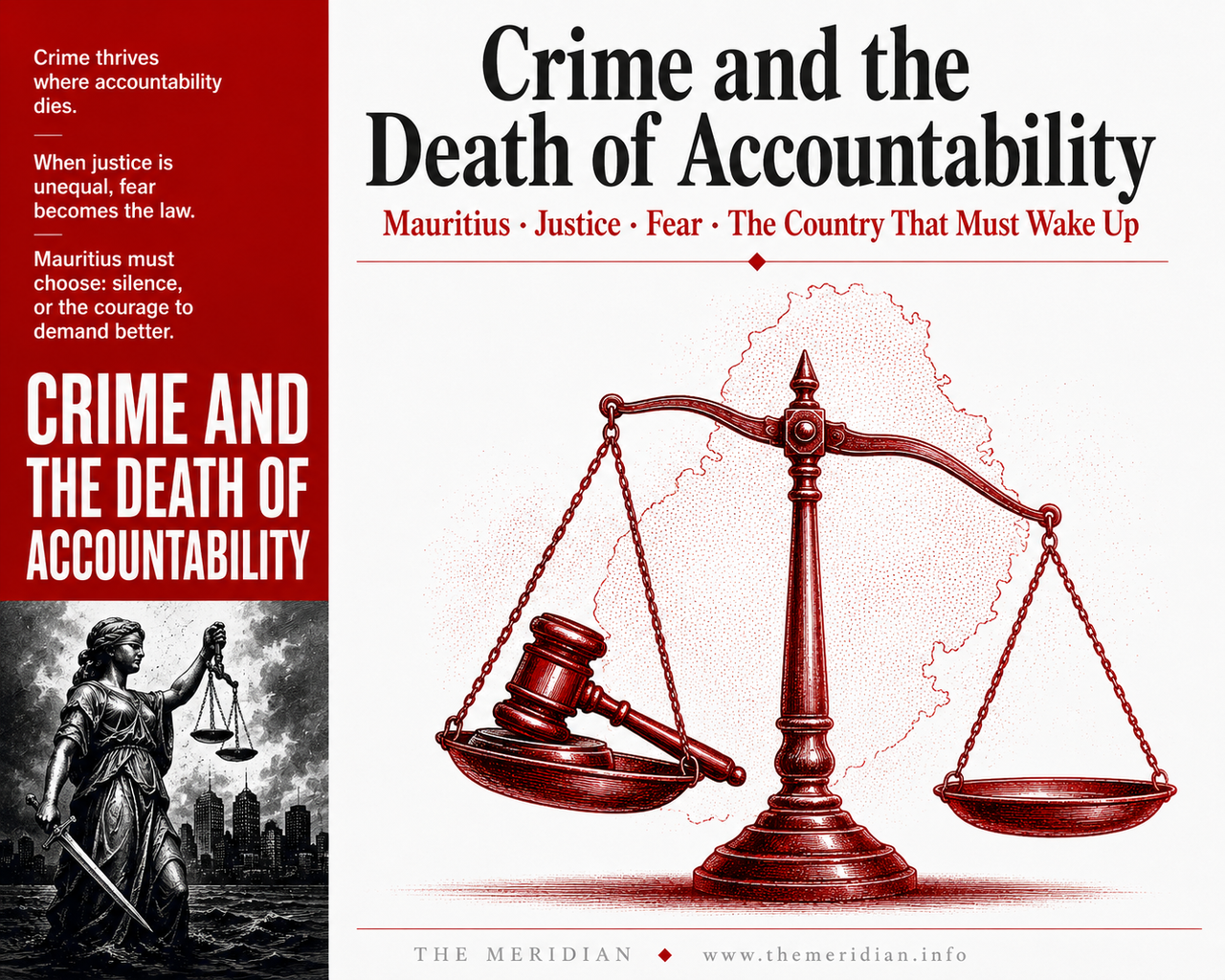
Crimes against persons rose 16.75 per cent in 2024-25. Forty-one murders. One hundred and forty-four police officers found guilty of disciplinary breaches. Thirty-three interdicted for criminal involvement. The Gino Bodha case. Michaela Harte. Vanessa Lagesse. Kistnen. Jim Browning delivers his most important Mauritius article yet: bring back accountability before bringing back the rope.
There comes a point when a country must stop pretending that everything is fine because the beaches are sandy, the sea is still blue, the hotels are still full, and politicians still know how to stand in front of cameras with solemn faces.
Mauritius is still beautiful. No one denies that. But beauty does not bury fear. Beauty does not comfort a mother who has lost her child. Beauty does not explain why families wait years for justice. Beauty does not explain why some investigations collapse, why some files seem to sleep in drawers, why the poor are punished quickly while the powerful have enough lawyers, delays and procedural gymnastics to make justice look like a private club.
Capital punishment was abolished in Mauritius by the Abolition of Death Penalty Act 1995. The law states clearly that the death penalty is abolished and that where a court could previously impose death, it must instead impose penal servitude for life. Yet today, many Mauritians are asking a painful question. If someone deliberately takes a life, destroys a family, removes forever the laughter, dreams, memories and future of another human being, what punishment is enough?
Human rights are important. Of course they are. A country without human rights becomes a machine. But whose rights are we really defending when the victim has no voice, no breath, no tomorrow, no birthday, no wedding, no Sunday lunch, no child to hold, no mother to kiss, no sea to enjoy, and no chance to grow old? The murderer, meanwhile, is fed, housed, medically treated and legally represented at the taxpayer's expense, including by the taxes of the victim's own family.
That is the cruelty people are afraid to say aloud. The culprit commits the crime. The victim's family receives the funeral, the trauma, the sleepless nights, the court dates, the unanswered questions and, through taxes, helps maintain the very system that feeds the person accused or convicted of destroying their life.
This is not justice. This is administrative politeness dressed up as civilisation.
The figures do not comfort the grieving
The Mauritius Police Force Annual Report 2024 to 2025 recorded 4,735 offences classified as crime, 42,546 misdemeanours and 4,347 drug cases for mainland Mauritius between July 2024 and June 2025. Reported drug cases rose by 3.8 per cent. More troublingly, crimes against persons increased by 16.75 per cent. The same report recorded 1,520 autopsies, including 41 classified as murder or voluntary homicide.
So when elected politicians say crime is going down, one must ask: going down for whom? On paper? In a ministry report? In a PowerPoint presentation? Try saying that to a family standing next to a coffin.
Statistics are useful, but they do not weep. They do not bury children. They do not wake at three in the morning because a memory has cut through the silence. A fall in one category of crime does not erase the rise of fear in people's homes. It does not erase the fact that citizens are changing the way they live because they no longer feel protected.
From unlocked doors to electric fences
There was a time in Mauritius when many people did not lock their doors at night. Families lived on the same road, sometimes in the same yard, and the greatest security system was the neighbour who knew your grandmother. Children walked freely. Doors were left open. A person could sleep with the sound of crickets rather than the anxiety of footsteps outside.
Now what do we have? CCTV cameras. Electric fences. Guard dogs. Alarm systems. Security companies patrolling residential areas. WhatsApp groups warning about suspicious cars. Elderly people afraid to open their gates. Parents tracking children as if we live in a war zone. People no longer simply live in their homes. They fortify them.
This is the real index of public fear. Not the official report. Not the ministerial speech. The real index is the fence outside the house, the camera above the gate, the panic when a strange car slows down near the wall, and the way families now say, almost casually, make sure you lock everything before you sleep.
A country does not become unsafe only when crime statistics rise. It becomes unsafe when decent citizens change their normal habits because they no longer trust that the law will arrive before the criminal does.
The case of Gino Ronnie Bodha
The recent case involving Gino Ronnie Bodha has reopened that wound. His body was found at La Nicolière after a missing person report had been filed, and the matter has been treated as a homicide investigation. Reports state that two suspects were arrested and maintained in police detention under provisional murder charges. At this stage, they remain suspects until a court decides otherwise.
But for the family of the victim, the damage is already immeasurable. Another life gone. Another family broken. Another country shocked for a week before moving to the next scandal.
The public must also be careful. Grief should not be turned into gossip. Rumour should not be dressed up as investigation. A murdered person is not a headline toy. A family's pain is not an opportunity for people to sound clever on social media. Let the courts do their work, but let the country have enough dignity to understand the human cost of what has happened.
Names that still disturb the national conscience
Gino is not an isolated story. Mauritius has carried too many names, too many files and too many wounds.
There was Michaela Harte, killed during her honeymoon in Mauritius in 2011. No one has been convicted of her murder, and two former hotel workers were acquitted in 2012 on technicalities. Her case remains one of the most painful stains on our national conscience because it exposed not merely violence, but the failure to deliver final justice to a grieving family.
There was Janice Farman, the Scottish woman murdered in Albion in 2017. Two men were later sentenced to 33 and 23 years respectively. In public reporting of the case, the absence of remorse became part of the public anger.
There was Vanessa Lagesse, whose case haunted the country for more than two decades. Bernard Maigrot was convicted in 2024 and then acquitted on appeal in 2025. Whatever one believes about the case, it is a brutal lesson in delay, doubt and institutional fragility. A justice system that takes decades to reach uncertainty cannot expect the public to feel reassured.
There was Soopramanien Kistnen, whose death became one of the most disturbing political and criminal controversies in recent Mauritian history. In October 2025, the Prime Minister stated in Parliament that Kistnen was indeed murdered and that the investigation would be reopened. The country was again reminded that truth, in Mauritius, often walks slowly when it should run.
There was Manan Fakoo, killed in Beau Bassin in 2021. The Commissioner of Police publicly stated that the killing was not communal and concerned a problem between individuals. That point matters. Murder must not be turned into ethnic poison. Crime must be judged by evidence, not by surname, religion, caste, neighbourhood or community.
There were the Sookur couple, Presram and Indira Sookur, whose deaths shocked Vacoas in 2023. Reports later said suspects arrested in that case also admitted involvement in the death of Khatiba Goburdhun, whose earlier death had been treated differently. Again, the question is not only who killed whom. It is how many things are missed before the truth finally appears.
There have also been attacks on tourists, hikers, security guards, police officers and ordinary citizens. Some have involved blades, sabres, armed robbery and serious injuries. A Czech tourist was reported to have suffered severe hand injuries during a robbery in Bel Ombre in 2023, while attacks against hikers and other members of the public have also been reported in recent years.
The exact facts of each case belong to the courts and investigators. But the national pattern belongs to us. The fear belongs to us. The shame belongs to us.
Drugs, schools and the loss of innocence
Then comes the drug problem. We cannot speak about crime in Mauritius without speaking about drugs. Not in whispers. Not in committee language. Not in the usual sensitisation campaign vocabulary that produces banners, speeches and refreshments while the problem walks out of school gates and into neighbourhoods.
In Parliament in October 2025, it was stated that 497 adults had been arrested for drug dealing and provisionally charged, and that nine minors had been identified for drug dealing, though none were provisionally charged. In March 2025, parliamentary debate referred to drugs, drug dealing, drug addiction and the large sums of taxpayers' money being spent on repression and treatment.
This is not a small social inconvenience. This is a national emergency. When minors are suspected of drug dealing, when schools are no longer only places of education but places of suspicion, when parents have to wonder whether their children are safe from substances before they are even safe from exams, the country is not merely facing crime. It is facing moral decay.
And what happens too often? The child from a poor family is dragged through the system. The one with a name, money, a lawyer, a connected family, or a family that knows how to call someone suddenly becomes a complicated case. Suddenly everyone discovers compassion, procedure, counselling, second chances and the future of the child.
But what about the future of the child who was harmed? What about the student who was introduced to drugs? What about the victim who cannot afford a top lawyer? What about the decent family that has to live with the consequences while the culprit's family organises strategy?
Mauritius is developing two justice systems. One for those who tremble before the law. Another for those who negotiate with it.
When even institutions lose credibility
The police should be the wall between society and criminality. Yet the police themselves have faced a credibility crisis. The Mauritius Police Force Annual Report 2024 to 2025 states that 144 police officers were found guilty of breaches of the discipline code, and that 33 police officers suspected of involvement in criminal cases were interdicted from duty.
The Global Organized Crime Index 2025 profile for Mauritius also reported that law enforcement efforts against heroin trafficking are hampered by corruption, and that police officers have been implicated in heroin trafficking.
Let that sink in. If the people meant to fight crime are themselves suspected in crime, the ordinary citizen is not paranoid. The ordinary citizen is paying attention.
This does not mean every police officer is corrupt. Far from it. Many officers do difficult work under pressure and with limited resources. But institutional credibility is not protected by pretending there is no problem. It is protected by punishing the problem openly, quickly and without political calculation.
The theatre of tribute politics
Then we have the great national theatre of tribute politics.
A tragedy happens. Politicians arrive. Flowers are placed. Statements are made. Faces are arranged into sadness. Someone says they understand the pain because they too have lost a loved one. Cameras click. Posts are shared. Condolences are offered. Then what?
What law changes? What enforcement changes? What sentencing policy changes? What lobbying takes place? What pressure is placed on the police, the prosecution system, the prisons, the education system, the drug enforcement system, the border control system and the machinery of justice?
If politicians understand grief so well, why do they not legislate with the urgency of grief?
It is not enough to attend funerals. It is not enough to issue condolences. It is not enough to say mo solider avek la famille and then return to Parliament to argue about allowances, nominations, contracts and political revenge. Lawmakers must be accountable for the laws they fail to pass, the loopholes they fail to close and the institutions they allow to rot.
Some will politicise a murder before the family has even had time to breathe. Others will visit, speak, post and disappear. This is not leadership. This is grief management for political optics.
Lawyers, rights and the missing humanity
The same uncomfortable question applies to lawyers. Every accused person has the right to legal representation. That is fundamental. A country without defence lawyers is not a democracy. It is a mob. But there is still a moral question.
When legal skill becomes a tool not to test evidence but to exhaust victims, delay proceedings, intimidate the weak, or help the wealthy turn justice into a waiting game, then the law may be functioning, but humanity is missing.
The poor man who steals food to feed his family is fined, shamed or imprisoned. The person accused of stealing millions of Rupees often discovers medical certificates, postponements, constitutional points, procedural arguments and high level representation. Years pass. Witnesses forget. Files weaken. Public anger cools. Then one day, after enough delay, the country is told there was not enough evidence.
How convenient.
A politician once said, moralité pas rempli ventre. Perhaps. But immorality empties a country's soul. And when a society loses its soul, no economic miracle, no smart city, no hotel award, no GDP chart and no ministerial speech can save it.
The small crimes that grow into national rot
Mauritius did not become fragile overnight. It became fragile because small wrongs were normalised.
A well connected man, who was once a political nominee, parked on double yellow lines. He was clamped. Instead of accepting that wrong is wrong, he called someone powerful; the chairman of the then NTA. The clamp was immediately removed. The traffic officer was punished. The offender said, "ar nous non? Nous qui au pouvoir". That is not a parking story. That is the entire disease of the country in one sentence.
When small laws are mocked, big laws eventually collapse. When a child sees adults escape consequences, the child learns that morality is for fools. When a political nominee can bully enforcement, the drug dealer learns the same language. When the connected person walks free, the criminal begins to believe the law is a gate, not a wall. A gate can be opened if you know the guard.
Normal citizens start thinking they are above the law because strictness has disappeared. The country becomes a place where people ask not what is right, but who can help. Not what is legal, but who can they call. Not what is moral, but who is in power.
Karma is not justice
Some people will say it is karma. That is an easy sentence to say when the coffin is not in your house. If karma exists, then let it visit those who commit the sins. It should not punish innocent parents, innocent children, innocent siblings, innocent spouses and innocent friends who did nothing except love the person who was taken from them.
Grief is not a spiritual talking point. It is not a Facebook quote. It is not a lesson for spectators. Families do not need philosophy when they are waiting for justice. They need action.
The country we used to claim to be
Mauritius was once admired for its education, hospitality, generosity, discipline, culture and sense of family. People were not perfect, but there was shame. Shame mattered. Elders mattered. Teachers mattered. Police mattered. Neighbours mattered. Prayer mattered. Reputation mattered.
Now shame has gone on leave without pay.
We have vulgarity dressed as confidence. Greed dressed as ambition. Political begging dressed as networking. Illiteracy dressed as opinion. Laziness dressed as victimhood. Jealousy dressed as social justice. Entitlement dressed as rights. Some people want everything on a plate, but not the discipline, sacrifice or morality that used to build a respectable life.
Most people will object and say, no, it is not everyone. Of course it is not everyone. There are still decent people. There are still parents trying their best, teachers trying to guide, police officers trying to serve, judges trying to decide fairly, neighbours trying to help, and citizens trying to live honestly. But the decent are becoming quieter while the shameless become louder. That is the danger.
Capital punishment, anger and the hard truth
So yes, the debate on capital punishment has returned emotionally because people are tired. They are tired of hearing about rights while victims are buried. They are tired of criminals showing no remorse. They are tired of watching accused persons smile for cameras. They are tired of families being told to be patient while suspects are protected by procedure. They are tired of politicians turning murder into a condolence opportunity.
Those who support the reintroduction of capital punishment will say this: certain murders are so deliberate, so cruel, so destructive, that life imprisonment does not answer the moral scale of the crime. They will argue that the person who intentionally removes another human being from the world has crossed a line that society must answer with the highest punishment. They will ask why the murderer gets years of meals, medical care, appeals and shelter while the victim gets a grave.
That argument is emotional, but it is not irrational. It comes from a place of pain.
However, the country must also be honest. Before Mauritius can speak seriously about bringing back capital punishment, it must first prove that its justice system is clean enough, fast enough, competent enough and independent enough to carry such irreversible power. A weak system should not be given the strongest punishment. If investigations are poor, if confessions are questionable, if files disappear, if influence exists, if the poor are crushed and the powerful glide through, then capital punishment becomes dangerous.
The death penalty debate therefore cannot be a slogan. It cannot be a campaign poster. It cannot be a revenge fantasy. It must be a national discussion about justice, evidence, accountability, victims, deterrence, institutional competence and the value of life.
The real demand
Perhaps the real demand should be this: bring back accountability before bringing back the rope.
Bring back proper investigations. Bring back serious sentencing. Bring back fast trials. Bring back forensic discipline. Bring back police integrity. Bring back border control that frightens traffickers. Bring back schools where students learn, not deal. Bring back consequences for politicians who interfere. Bring back punishment for officers who abuse power. Bring back protection for victims and witnesses.
Bring back a justice system where the poor, the rich, the connected and the unknown all face the same law.
And above all, stop turning crime into a communal issue. The criminal has no noble ethnicity when he kills. He has no respectable religion when he destroys a family. He has no community honour when he traffics drugs, attacks the innocent or hides behind political protection. Anyone trying to make this about ethnicity, religion or caste is doing free public relations for criminals. The real divide is not Hindu, Muslim, Christian, Creole, Franco, Sino or anything else. The real divide is between those who respect life and those who do not.
Mauritius must wake up
Mauritius must wake up.
Not after the next murder. Not after the next school drug scandal. Not after the next police officer is arrested. Not after the next tourist case damages our reputation. Not after another mother has to identify her child. Now.
A country does not collapse in one dramatic moment. It collapses slowly, through excuses, favours, silence, cowardice, selective outrage, political interference and the repeated refusal to punish wrongdoing when it is still small.
Capital punishment may or may not return. That is for Parliament, the courts, the Constitution and the people to debate properly. But accountability must return. Fear of the law must return. Shame must return.
Because if the law does not protect the innocent, the innocent will eventually stop believing in the law. And when that happens, no politician's speech, no human rights slogan, no religious sermon and no national anthem will be enough to hold the country together.
Immediate accountability measures that should be discussed
- A statutory duty to publish clear progress updates in major homicide investigations, without compromising evidence.
- A specialised victims' family liaison unit with trained officers and time bound communication duties.
- Fast track courts for murder, violent robbery, serious drug dealing involving minors and violent offences against tourists or vulnerable persons.
- Stronger witness protection and consequences for witness intimidation.
- Mandatory internal disciplinary publication where public officers are convicted of corruption or serious criminal conduct, subject to privacy and legal rules.
- A national school drug response protocol that treats students as children in need of protection, while holding suppliers and adult networks severely accountable.
- A sentencing review for aggravated murder, repeat violent offending, violent robbery and drug dealing around schools.
- Clear offences and penalties for political or administrative interference with enforcement officers carrying out lawful duties.
- Politicians taken to task and punished when proven guilty and the investigation is not carried out by local forces but international bodies such as Interpol or the FBI.
Add comment
Comments