How Mauritius Preserved a High-Cost Sector
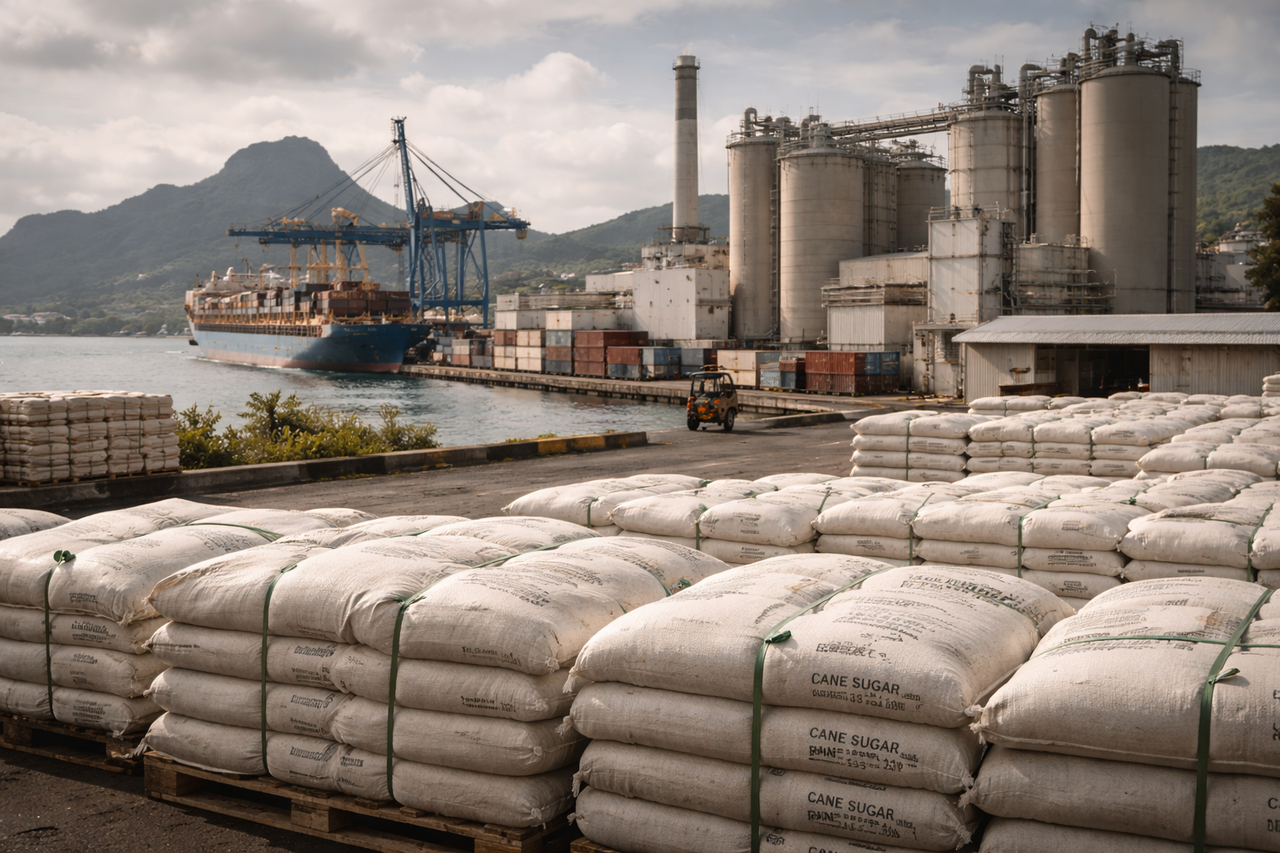
The Mauritian sugar sector is usually discussed in the language of heritage, resilience and export tradition. That language is not innocent. Sugar is not merely a crop in Mauritius. It is one of the founding structures of the post-colonial economy, one of the oldest concentrations of land and capital on the island, and one of the clearest examples of how a sector can lose economic centrality without losing political protection. That is why the debate must now move beyond nostalgia. Mauritius is not legally obliged to produce sugar. It enjoys export access and tariff-rate opportunities abroad, but these are rights to export, not duties to preserve cane at all costs. The fact that the State still protects sugar so strongly is therefore not a legal necessity. It is a policy choice. And policy choices can be examined, questioned and changed.
The old political story was simple. Sugar earned foreign exchange, justified land concentration, sustained rural livelihoods and anchored the post-colonial economy. That story is now considerably weaker. Official data from Statistics Mauritius show that sugar production fell from 238,854 tonnes in 2023 to 225,547 tonnes in 2024, a decline of approximately 5.6 percent in a single year. Cane production fell from 2,452,653 tonnes to 2,195,802 tonnes over the same period, while harvested area declined from 35,863 hectares to 34,759 hectares. The sector remains real and contributes to foreign exchange earnings, but it is smaller, thinner and less economically decisive than the mythology consistently suggests.
What has not weakened at the same pace is its institutional protection. The Mauritius Cane Industry Authority's own revenue structure records the ex-Syndicate sugar price, bagasse proceeds, molasses proceeds, waiving of cess, estimated waiving of SIFB premiums for some planters, and an explicit additional contribution from the Government to meet the guaranteed sugar price. That is not the language of a sector fully exposed to market discipline. It is the language of preservation by design, and it reveals that the State has consistently chosen to interrupt the market verdict rather than allow it to complete.
The central issue is not whether sugar still exists. It does, and it still contributes to export revenue and rural economic life. The issue is whether Mauritius has continued to preserve sugar as though it remained a sovereign commercial pillar when the evidence now points to something structurally different: a politically protected sector whose commercial logic has weakened, whose domestic production base is narrowing, and whose trade reality is more complicated than official narrative suggests.
The Mauritian sugar economy was never low-cost in any simple or sovereign sense. A commodity is genuinely low-cost only when the factors of production beneath it are durably competitive on market terms without external support. Mauritius does not control the world price of sugar. It does not control freight conditions. It imports significant inputs including fuel, fertiliser and, as the trade data reveal, raw cane sugar itself at large scale. It faces energy exposure that rises with every global oil shock. It carries labour costs that are high relative to many competing producers in Asia, Latin America and Africa. What made the sector appear commercially manageable for so long was not sovereign efficiency alone. It was the repeated political management of cost.
Those costs were softened through multiple channels. Land was historically concentrated and already held under arrangements that predated independent market competition. Public support intervened repeatedly to preserve planter revenue through guaranteed price mechanisms. Co-products including bagasse for electricity generation and molasses for rum improved the system economics materially. The State waived levies and premiums that would otherwise have fallen directly on producers. The sector survived partly because the full market verdict was consistently interrupted by design. A sector in that position can only sustain itself if it is genuinely low-cost, strongly differentiated through quality and branding, or politically protected. The honest reading of the evidence is that Mauritius has increasingly relied on the third condition while narrating it as the first.
The Mauritian sugar economy was not low-cost in any sovereign sense. It was made to appear manageable because key market pressures were softened, deferred or transferred elsewhere. The difference between those two things is the difference between resilience and dependence.
Vayu Putra · The Meridian · April 2026The most analytically significant evidence comes not from production statistics but from trade data. In 2023, Mauritius imported 132,575,000 kilograms of raw cane sugar, of which 131,644,000 kilograms came from Brazil, at a trade value of approximately $75.2 million. This is not marginal balancing. It represents structural dependence on imported low-cost sugar from the world's dominant producing economy, at a volume that is impossible to reconcile with the straightforward image of Mauritius as a self-sufficient sugar exporter.
Mauritius now operates what appears to be a two-tier sugar economy. On one side stands the premium narrative: Mauritian sugars, refined output, geographic branding, specialty market access and the export identity that generations of policy have constructed. On the other stands the industrial reality: raw cane sugar arriving from Brazil at 131.6 million kilograms per year. Commercially, this may represent rational differentiation: a high-cost island reserving its own production for higher-value streams while importing cheaper bulk for refining or local industrial use. Politically, the implication is severe. It means the sugar identity that the State continues to protect and subsidise no longer rests fully on a domestic production base that can compete unaided on global market terms. Mauritius cannot simultaneously claim sugar as a pillar of national economic self-sufficiency and import effectively all of its raw cane from the world's lowest-cost producer. That is managed contradiction, and the current policy of preservation does not honestly confront it.
The defence of sugar is frequently framed to sound compulsory, as though Mauritius must keep producing because external agreements require it. That framing is no longer accurate. The old ACP-EU discipline that previously tied export volumes to quota compliance is gone. What remains are market-access arrangements: duty-free, quota-free access under the Economic Partnership Agreement framework, a tariff-rate quota under the China-Mauritius FTA, a quota under the India CECPA agreement, and other bilateral access windows. These matter commercially and should be used strategically. But they do not compel the State to preserve the domestic sugar sector at any fiscal or political cost. They are export rights, not production duties.
Once obligation disappears, preservation must be justified on its own terms: economic, social, fiscal and distributional. The current debate in Mauritius has not consistently made that justification explicitly or rigorously. A government that chooses to protect a high-cost sector must explain, in public terms, why the wider economy should carry that cost, who benefits from the protection, and whether an alternative allocation of the same resources would serve more citizens more effectively.
The shift from obligation to opportunity is analytically decisive. Once export access becomes a right rather than a delivery duty, the continued preservation of a high-cost sector can no longer be defended as externally imposed necessity. It must be explained as a domestic political choice, and political choices carry a different standard of justification. They must be defended on evidence, not on inherited assumption.
The structural weakness of the sugar model is not only historical or institutional. It is operational and immediate. In April 2026, The Meridian documented how Mauritius approached harvest season under visible fuel stress. Diesel had been repriced upward by approximately 9.9 percent in a single adjustment to Rs 64.80 per litre. Heavy fuel oil procurement costs had risen as a consequence of Middle East supply disruption through the Strait of Hormuz. The State was already carrying approximately Rs 1 billion in unplanned fuel expenditure within a fifteen-day window before the cane campaign had properly begun. That matters because sugar is not merely a land-and-export narrative. It is a fuel-intensive industrial chain in which cane must be cut, loaded, hauled to mills and processed through heat and electricity-intensive operations, in an island economy that imports the fuel those operations depend on and does not control its price.
Sugar exports at prices set in London and New York. Fuel imported at prices set in Riyadh and Houston. The burden lands in Port Louis, on the public accounts of an island that controls neither rate. That is the trap in its simplest form.
Vayu Putra · The Meridian · April 2026The wider structural trap is deeper still. Mauritius exports sugar at prices it does not set, imports fuel at prices it does not control, and relies on domestic subsidy and pricing mechanisms to absorb the strain that follows. The burden does not disappear. It is recycled internally through administered prices, public intervention and the taxpayer base, adding to a fiscal deficit that already stands at 9.3 percent of GDP against a 60 percent statutory debt ceiling already breached by 26.5 percentage points. Sugar is therefore not only a protected agricultural sector. It is one of the clearest examples in the Mauritian economy of how external pricing exposure and domestic fiscal cushioning are structurally fused, creating a loop in which dependence is managed but never resolved.
When domestic sugar revenue is externally priced while diesel, electricity and logistics are exposed to imported energy shocks, the pressure has only three places to land: the grower, the taxpayer or the State balance sheet. In practice, all three absorb some share simultaneously. That is why the sugar question is no longer only agricultural. It is fiscal, industrial and political at the same time, and it becomes more acute every time an external shock makes the energy import bill more expensive.
Once the State cannot control the world commodity price, imported input costs, freight exposure or foreign demand conditions, it turns toward the variables it can still influence. Labour is one of them. This does not mean every labour arrangement in every sector is exploitative. It means that in structurally pressured export economies that cannot compress global commodity prices, labour frequently becomes one of the remaining margins through which apparent competitiveness is defended.
Mauritius' wider labour record makes this harder to ignore. The island has projected stability and rules-based governance internationally for decades. Yet its treatment of migrant workers in labour-intensive sectors has repeatedly drawn scrutiny from foreign governments, international labour organisations and independent observers. When Mauritian workers reject jobs that no longer sustain a viable life at current price levels, the system does not always respond by raising wages, improving conditions or redesigning the sector. Often it widens access to more vulnerable labour pools, typically migrant workers from lower-income economies who have fewer alternatives and less bargaining power. That is not merely a moral problem. It is an economic diagnosis: the apparent commercial viability of exposed sectors is maintained by suppressing one of the few remaining cost variables still considered politically adjustable.
A common error in public debate about sugar is the assumption that because the sector is described as national, any support for it automatically serves the whole country equally. Much of the sector's ownership, land and commercial benefit remains private and historically concentrated, while significant parts of the preservation architecture are public or quasi-public. The sector's commercial income does not simply flow back into the State or distribute equally across the population. Yet the State repeatedly enters to preserve its economics, waive its obligations and guarantee its prices. This asymmetry is the key structural question that the political debate consistently avoids.
The Mauritian citizen who does not own cane land, does not sit inside an estate or milling structure, and does not directly capture export margins may still carry the system through tax revenues, foregone fiscal income from waivers, energy cross-subsidisation and policy support budgeted at public expense. The question is therefore not only agricultural. It is fiscal and distributive. Why should a broader public continue to help sustain a high-cost, price-taking sector if the benefits of ownership are more concentrated than the burden of preservation? That question has not been honestly answered in Mauritian public policy for a very long time.
The answer is not that sugar still makes compelling commercial sense on market terms. It does not, or at least not without the support structures that the market price does not provide. The answer is that sugar still does significant political and institutional work. It preserves existing land regimes and the concentration of capital associated with them. It stabilises established economic interests whose political reach extends across the major parties. It sustains a vocabulary of continuity that helps governments avoid more difficult conversations about land redistribution, food security policy and the post-colonial distribution of productive assets. It supports linked arrangements in bagasse electricity, rum export and rural economic management that have become embedded in wider policy structures.
That is why sugar survives: not because its commercial logic is beyond question but because too many other questions would become unavoidable if it were treated honestly on economic terms alone. The State has chosen, across multiple governments and multiple economic cycles, to manage sugar's decline rather than decisively reprice its place in the national economy. That is not agricultural policy in any narrow or technical sense. It is political management of inherited institutional power dressed as sectoral continuity.
Mauritius did not merely inherit the sugar sector. It has chosen, repeatedly and deliberately, to preserve it. The republic is no longer dealing with a sector sustained by legal obligation or overwhelming commercial competitiveness. It is dealing with a sector sustained by policy preference, protected by national narrative, and increasingly contradicted by its own trade data. The importation of 131.6 million kilograms of raw cane sugar from Brazil in a single year, while simultaneously defending domestic sugar as a pillar of national economic identity, is not a coincidence. It is a structural symptom of a model that has chosen continuity over honesty.
The 2026 energy shock has sharpened the diagnosis rather than softened it. Sugar is not only a historically protected sector. It is an operationally fragile one, exposed to imported fuel costs at precisely the moment the State has the least fiscal room to cushion the consequences. The government carries a deficit of 9.3 percent of GDP, a public debt ratio of 86.5 percent against a 60 percent statutory ceiling, and an unplanned fuel cost burden of approximately Rs 1 billion that had already arrived before cane cutting began in earnest. Every rupee of sugar support now competes directly with the fiscal obligations of a state that is already beyond its own legal limits.
If sugar is no longer legally required, no longer sovereign in price, no longer self-sufficient in raw material and no longer low-cost without public support, then the question is not whether Mauritius can still export sugar. The question is whether it has spent too long preserving a structure that serves the continuity of existing interests better than it serves the long-term autonomy of the national economy. That question deserves an honest answer, and Mauritius has been avoiding it for more than a generation.
April 2026 · Political Economy · Mauritius Investigation